Bedding · Fabric & finish
Hemstitch Sheets: What the Classic Edge Means for Comfort and Care
A row of tiny openwork bars can make a plain sheet feel quietly dressed. But hemstitching is a finishing detail, not a promise about softness, strength, or sleep. To choose well—and keep the detail intact—look beyond the hem.
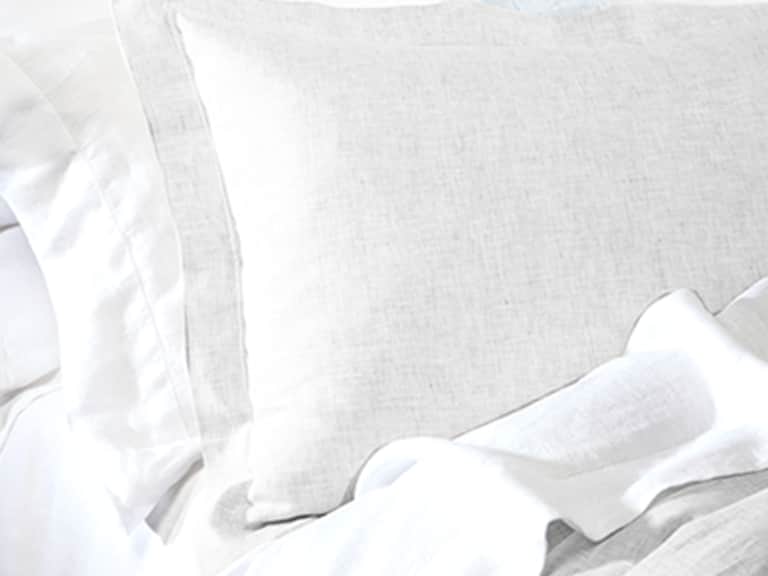
There is a particular satisfaction in noticing the edge of a well-made sheet. The fabric may be simple, the color familiar, the bed only half made; then a narrow line of openwork catches the light, and the whole thing seems to have acquired a little composure. Hemstitching has this modest theatricality. It does not announce itself from across the room. It waits at the border, where a hand smoothing the sheet or a pillowcase turned back might discover it.
That small detail can also invite outsized expectations. A hemstitch may suggest careful workmanship, old-fashioned refinement, or a textile meant to last. Sometimes it accompanies excellent materials and construction. But the stitch itself does not tell us whether a sheet is especially soft, breathable, durable, or suited to a particular sleeper. Those qualities have more to do with the fiber, the weave, the fabric’s weight and finish, the seams, and the way the sheet is cared for.
Understanding what the edge is—and what it is not—makes shopping less mysterious. It also helps with laundry, where a fine openwork border can be more vulnerable than the uninterrupted cloth beside it. The hem deserves attention, but not reverence. It is a detail in a larger piece of textile arithmetic.
What hemstitching actually does
In a traditional hemstitch, a narrow band of threads is drawn out of the fabric near its edge. The remaining threads are then secured into small, even groups with stitching. Those groups form the characteristic ladder-like bars, or openwork. The hem itself is turned and sewn to prevent the cloth from unraveling; the decorative stitching creates a delicate window between that finished edge and the body of the fabric.
There are variations in how the work is made. The scale of the openwork, the spacing of the bars, the number of drawn threads, and whether the stitching is done by hand or machine can all change the appearance. On a flat sheet, the detail often runs along the top hem, the part that may be folded over a blanket. On a pillowcase, it may frame the opening or appear along a cuff. The design can be barely perceptible or sufficiently pronounced to become the main ornament.
The technique is decorative, but it is not merely an applied trim. Because some threads are removed and the remaining ones gathered, the finish depends on the structure of the cloth and the precision of the work. A neat hemstitch has regular spacing, secure bars, and a finished hem that lies flat. A loose or uneven border may snag more readily or distort in washing. These are useful clues about execution—not a substitute for inspecting the rest of the sheet.
It is also worth separating hemstitching from other edge treatments. A hemstitched edge has openwork made from the fabric’s own threads. A hemstitched line may sit beside a plain hem, while a flange adds a wider fabric border that projects beyond a seam. Embroidery, piping, scalloping, and lace can produce related impressions of refinement, but each has a different construction and may require different handling.
A handsome edge is not a comfort technology
It is tempting to read the hem as a forecast of the night ahead. The word “fine” appears in descriptions of both fabric and workmanship; the eye sees a tidy border and imagines a cooler, softer bed. But a hemstitch does not materially change the feel of the broad surface against the body. It does not make a cotton sheet more breathable, or linen less textured, or a fabric more effective at managing warmth.
For comfort, begin with fiber and weave. Cotton sheets may feel crisp or smooth depending on their construction and finish. Percale, a plain weave, is often chosen by people who enjoy a cool, dry hand. Sateen, with a different weave structure, tends to feel smoother and more lustrous. Linen, woven from flax, is typically more textured at first and often softens with repeated use and laundering. None of these generalizations can settle every question of preference: a person’s sensitivity to texture, room temperature, sleepwear, and bedding layers all matter.
Thread count can be one part of a description, but it is not a universal quality score. Its meaning depends on how the threads are counted and the fabric is made. Fiber length, yarn quality, weave, finishing, and construction also shape the result. A very high number on a label cannot, by itself, guarantee a sheet will feel good or wear well. Nor does a delicate-looking border prove that the underlying cloth is exceptional.
Fit and construction are less romantic, but often more consequential. A fitted sheet needs to suit the mattress depth, including any topper. A flat sheet should be wide and long enough for the way the bed is made. Secure seams and appropriately finished corners help a sheet stand up to ordinary use. If a sheet set includes pillowcases or decorative details, check which pieces carry the hemstitch and where it is placed. A beautifully finished edge is of limited use if the sheet slips off the mattress by morning.
How to assess hemstitch sheets before choosing
When evaluating hemstitch sheets, treat the border as one feature among several. First decide what the main fabric should feel like. If possible, handle a sample or a similar fabric in person; otherwise, read descriptions carefully and distinguish concrete details—such as fiber content and weave—from broad claims about luxury or comfort. A linen sheet and a cotton percale sheet can both have hemstitching, yet they will not feel alike simply because their edges share a technique.
- Check the fiber content. Look for a clear statement of what the fabric is made from, rather than relying on a name, finish, or color description.
- Consider the weave and hand. Percale, sateen, and linen have different textures and drapes. Choose by preference and climate, not by the hem alone.
- Inspect the openwork. The bars should appear reasonably regular, with no conspicuously loose threads or abrupt gaps. If examining a finished item, look for a hem that lies flat.
- Read the size and fit details. Mattress depth, pillow dimensions, and the contents of a set matter more to daily usefulness than decorative edging.
- Read the care label before buying. Recommendations can vary with fiber, dye, finish, and construction. A delicate detail is easiest to preserve when its care routine suits your household.
Consider how the border will be used. A top hem that is folded back nightly may be visible and handled often. A pillowcase edge can rub against hair or skin and may meet jewelry, buttons, or a rougher surface in the wash. If the bed is made quickly, a very fine openwork detail may call for more care than a simple plain hem. That does not make it impractical; it simply turns the choice into a question of habits as well as taste.
Look, too, at the relationship between the detail and the fabric. A restrained row of openwork can give a plain white sheet definition without adding color or pattern. On a textured linen, it may sharpen the line of the hem. On a smooth cotton, it can create a subtle contrast between the dense cloth and the airy edge. In either case, the appeal is visual and tactile at the border. It need not be defended as a sleep aid.
Caring for the openwork edge
Bed linens are made to be used, and their care should not become an elaborate ceremony. Still, the open spaces and gathered threads in a hemstitch can catch on zippers, hooks, rough seams, or other items in a crowded load. A few ordinary precautions reduce that risk: sort linens by color and fabric weight, close zippers on other garments, and avoid filling the washer so tightly that the sheets cannot move freely.
Follow the instructions on the item’s label. Different fibers and finishes call for different temperatures and drying methods, so there is no single washing rule for all hemstitch sheets. When the label permits, a gentle cycle and moderate water temperature can be kinder to fine construction than aggressive washing. Use detergent in an appropriate amount; excess can remain in the fabric or contribute to a dull, stiff feel. Fabric softener is not automatically necessary and may not suit every fiber or finish.
Bleach merits particular caution. Chlorine bleach can weaken some fibers, affect color, or contribute to yellowing, and its use is not justified by the presence of a white hem. Avoid it unless the care instructions specifically allow it. If a stain needs treatment, work from the fabric’s care guidance and choose a method compatible with the fiber rather than applying a strong product to the border as a first resort.
Drying is another moment when small details can be strained. Over-drying may make some fabrics feel harsh or increase wrinkling; high heat can be inappropriate for certain fibers and finishes. Follow the label, remove sheets promptly when practical, and untangle them before folding. If a hem has become twisted in the dryer, do not pull at a loop or open bar. Ease the cloth apart gently. A snag is easier to address before it becomes a run of pulled threads.
Ironing is optional and depends on the look you want and the fabric’s instructions. If you prefer a crisp finish, iron the hem with care rather than pressing hard across the openwork. A low or moderate setting appropriate to the fiber, and a slightly damp cloth where recommended, may help smooth the edge without flattening or distorting it. Many people prefer the relaxed creases of linen; others like the order of a pressed top hem. There is no moral distinction between the two beds.
A real-world example: hemstitch on linen
The DownTown Company Layla Linen Duvet Cover illustrates how hemstitching can appear as one part of a larger textile design. Its description specifies 100 percent flax linen, a stone-washed finish, and a hemstitch detail with a flange. Those facts describe separate features: the linen identifies the fiber, stone-washing describes a finishing treatment, and the hemstitch and flange shape the edge. The border does not, by itself, explain the cover’s breathability or softness; those qualities relate chiefly to the fabric and its construction.
This is a duvet cover rather than a sheet, but the distinction is useful. Bedding descriptions often gather several attractive details into one sentence, as if they were interchangeable evidence of quality. They are not. A hemstitch tells you about the edge. A fiber label tells you what the cloth is made from. A care label tells you how the finished textile is meant to be laundered. Reading each detail for what it actually says is a practical form of discernment—and a good way to avoid buying a decorative finish in the hope that it will solve a comfort problem.
When the detail is worth choosing
There is no need to be either dazzled by hemstitching or suspicious of it. A carefully made edge can lend a sheet a sense of finish and make an otherwise simple bed feel intentional. It can also be a pleasure precisely because it is not useful in any grand way. A narrow line of openwork does not cool the room, improve posture, or make sleep arrive on schedule. It offers a small visual rhythm, a trace of handwork—or of work made to imitate its regularity—and a pleasant point of contact between cloth and eye.
For some households, that is enough. Others would rather spend their attention on a smooth fitted sheet, a preferred weave, or laundry instructions that suit a busy week. The best choice is the one that makes sense for the sleeper and the bed: a fabric whose feel is welcome, a fit that stays put, and a construction that can be cared for without anxiety. A hemstitch can complete that choice, but it cannot make it on its own.
In the end, the classic edge means what good finishing often means: someone considered how the cloth should end. It is a modest distinction, visible at close range and especially satisfying when the rest of the sheet is well chosen. Let it catch the light. Just do not ask it to carry the whole night.
Quick answers about hemstitch sheets
Does hemstitching make sheets softer?
No. It is an edge finish and does not determine the feel of the main fabric. Fiber, weave, finishing, and use influence softness.
Is a hemstitch a sign of better-quality sheets?
Not by itself. Regular, secure stitching can indicate careful execution, but overall quality depends on the cloth, seams, fit, and construction as well.
Can hemstitch sheets go in a washing machine?
Many can, but the correct method depends on the fiber and manufacturer’s instructions. Use the care label as your guide, and avoid overcrowding the load or pulling at loose threads.
Should I use bleach on white hemstitch sheets?
Do not assume white fabric is bleach-safe. Chlorine bleach can damage some fibers or finishes; use it only if the care instructions explicitly permit it.
What matters most when choosing a sheet set?
Start with fiber, weave, feel, size, fit, and care requirements. Treat decorative details such as hemstitching as a finishing preference—not as a measure of sleep performance.